|
| This Week... |
|
The beginnings of Sega Genesis/Megadrive support in Gamefu. kdegames improvements continue with porting and gameplay work in KBackGammon. OpenDocument master page support in Okular. 'Idle time' detection comes to the 'powermanager' module of the Guidance system utilies. MIDI format support in KTabEdit. The new histogram graphing functionality of Strigi continues to be refined. Following Akonadi, NEPOMUK starts to utilise the power of Strigi. WHATWG audio objects supported in KHTML through Phonon. Appointment printing work in KOrganizer. Kross scripting infiltrates KWord.
|
John Tapsell, the lead developer of KSysGuard, talks about the suite of improvements in progress:
|
The KDE task manager, KSysGuard, has seen many improvements across the board, and these enhancements can be experienced in both KDE 3.5.6 and in KDE 4. Over a dozen filed bugs have been fixed, with several wishes fulfilled. Most notable are the "Disconnection to localhost" problems that should now be fixed in both the main KSysGuard application and in the System Guard kicker applet (in both 3.x and 4) along with numerous painting/rendering bug fixes.
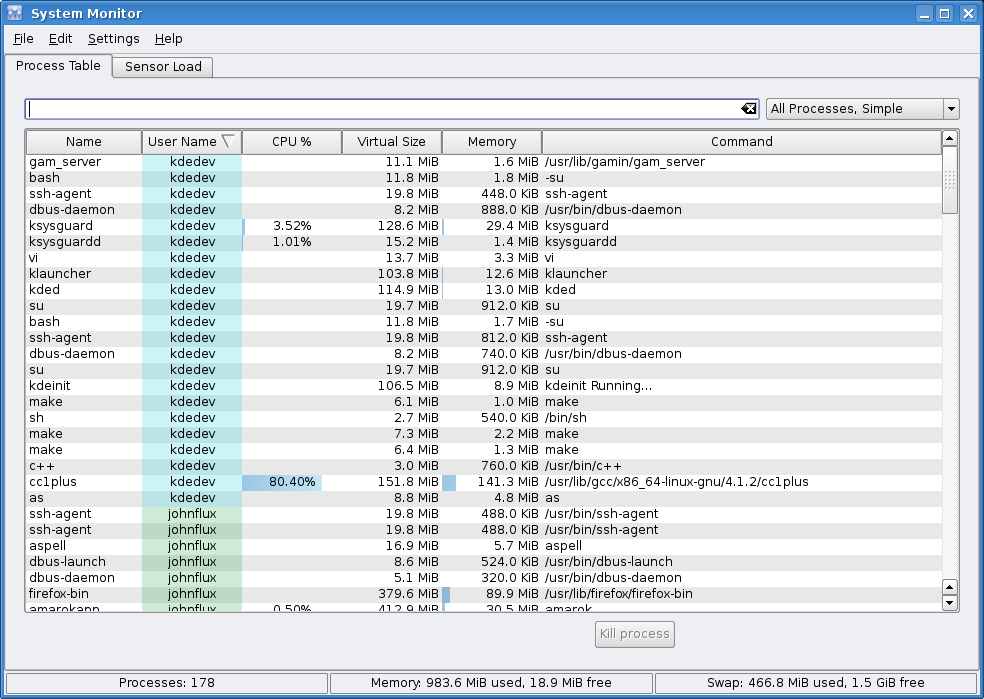
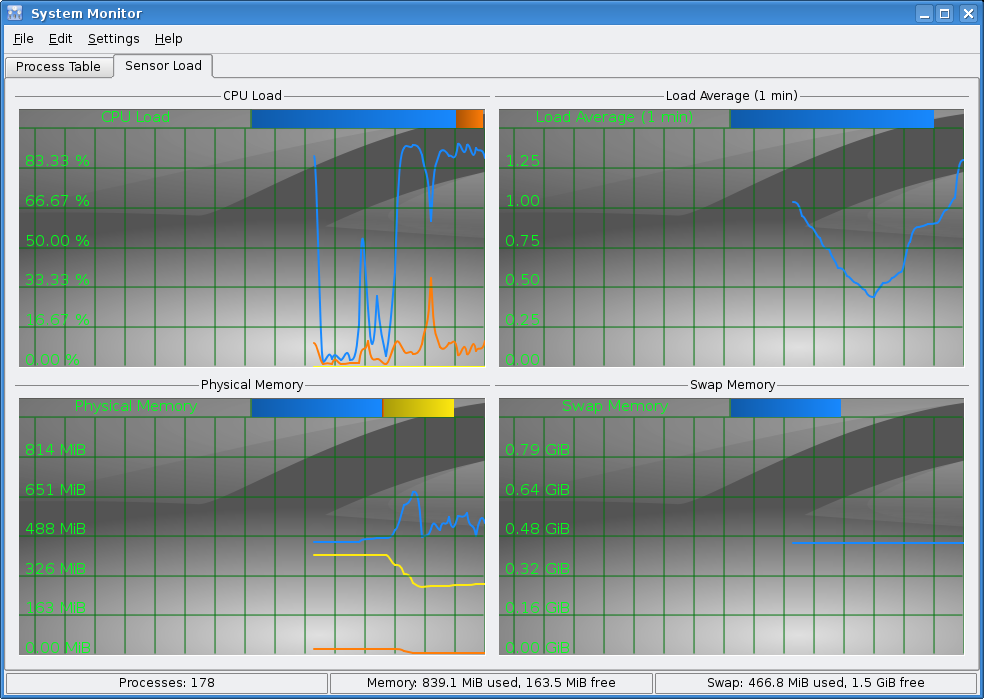
The main new features already implemented for the version that will be shipped with KDE 4 are:- The graphs are anti-aliased, with beautifully-smooth bezier curves connecting the points.
- SVG support for the graph plotter backgrounds.
- Units are shown within graphs, with nicer tooltips showing a key along with the current values.
- The list of processes is greatly simplified, with the default sorting being by user 'type' first (own user, other users, system), and then by CPU usage.
- Subtle colors are used to enhance usability, using the Oxygen colors.
- A more complex process list shows information such as the amount of X-Server memory a process uses, and the window title of the application.
- A large amount of work has gone into performance, startup time and memory usage optimisation.
- A beautiful, semi-transparent gradiented progress bar is shown for the CPU percentage and memory usage, again also using the Oxygen colors.
Here are some screenshots of the improvements:
|
|
Sebastian Trueg, a key architect of the NEPOMUK-KDE collaboration, explains the NEPOMUK concept and its relation to the future KDE desktop:
|
There has been quite some progress in the NEPOMUK-KDE project over recent weeks. But before I dive into that, it is probably a good idea to explain the purpose of the NEPOMUK-KDE project again. I won't explain the whole NEPOMUK project here since it is far too much for this text (and for me as well ;). Thus, let me just give a rough image of what I am working on right now.
As far as we can determine, there are three types of meta data:- Meta data that is stored with the data itself and is available all the time. This includes id3 tags, the number of pages in a PDF document, or even the size of a file or the subject of an email.
- Meta data that is manually created by the user, like annotations or tags that are assigned to files, emails, or whatever resources.
- Meta data that can be gathered automatically such as the source of a downloaded file, the email an attachment was saved from or the original location of a file copied locally.
The first type of meta data is already widely handled. Desktop search engines like Strigi index this information and we can always look at the meta information in the nice KFile dialog. But what about the other two types? Type three can be found in some applications like photo managers but their extra meta data never leaves the scope of the application.
This is where the current work in the NEPOMUK-KDE project comes in. We store arbitrary meta data in a local RDF store and provide convenience wrappers around it to access this data. The simplest method being the D-Bus interface.
But now to the actual implementation progress: I just finished the inappropriately-named libKMetaData. KMetaData is a wrapper around the RDF services that allow very easy handling of the meta data of type two and type three. Part of the NEPOMUK project involves creating a desktop ontology that provides categories and classes of meta data and their relationships. KMetaData contains a code generator that creates convenience classes from this ontology which can then be used to read or write meta data.
Let me give an example: Say we have a file, /home/trueg/foo.bar and we want to add a comment (annotation) to it. We simply create an instance of Nepomuk::KMetaData::File and use its methods like so:
Nepomuk::KMetaData::File f( "/home/trueg/foo.bar" ); f.setAnnotation( "This is just some test file I use to present this feature");
and we are done! KMetaData takes care of syncing this information into the local RDF store. Now any other application can access this data the same way:
Nepomuk::KMetaData::File f( "/home/trueg/foo.bar" ); myDisplayLabel->setText( f.getAnnotation() );
Simple as that. I have created three tools that use KMetaData: the simple annotator, the simple tagger, and a Strigi plugin which allows to search this manually created meta data. Thus, tag your files and find them again with Strigi by using the tags.
And this works beyond merely files and annotations. Although at the moment the NEPOMUK ontology does not yet fully exist - with only a placeholder that defines annotations and tags - libKMetaData is already very powerful and extensible: all classes like File are based on the generic Resource class and only use its setProperty and getProperty method to change values. Therefore, one can even create and read data of unknown resources (although in the future I hope to cover almost everything with our ontology).
I hope that in the future this technology can be integrated into KDE in order for each application to create meta data for arbitrary resources. We then have all the information we need in order to help the user as much as possible in their daily work.
|
|
|
| Statistics |
|
| Contents |
|
|
Bug Fixes |
Features |
Optimise |
Security |
Other |
|
Accessibility |
|
|
|
|
|
|
Development Tools |
|
|
|
|
|
|
Educational |
|
|
|
|
|
|
Graphics |
|
|
|
|
|
|
KDE-Base |
|
|
|
|
|
|
KDE-PIM |
|
|
|
|
|
|
Office |
|
|
|
|
|
|
Konqueror |
|
|
|
|
|
|
Multimedia |
|
|
|
|
|
|
Networking Tools |
|
|
|
|
|
|
User Interface |
|
|
|
|
|
|
Utilities |
|
|
|
|
|
|
Games |
|
|
|
|
|
|
Other |
|
|
|
|
|
|
|
Bug Fixes |
|
|
|
|
|
|
|
|
|
Megan Webb committed changes in /branches/kdevelop/3.4/parts/astyle:
|
Option to set the file type to enable the Edit/Format menu. (RMB context menu continues to ignore this setting)
Option in formatter settings to format a selection of files. |
|
| | | |